
An age of objects
Between the end of the war and the end of the 1970s Italy did something that no other country managed in quite the same way. It rebuilt its factories and, in the same breath, asked its architects to draw what went inside them: the chair, the lamp, the typewriter, the radio. Patrons with a taste for ideas ran companies that made things, and the architects who worked for them came from the same Milan, the same Turin, the same magazines, the same cafés as the painters. The result, a few decades on, is what collectors call modernariato: the signed objects of the twentieth century that no longer belong to the shop but to memory.
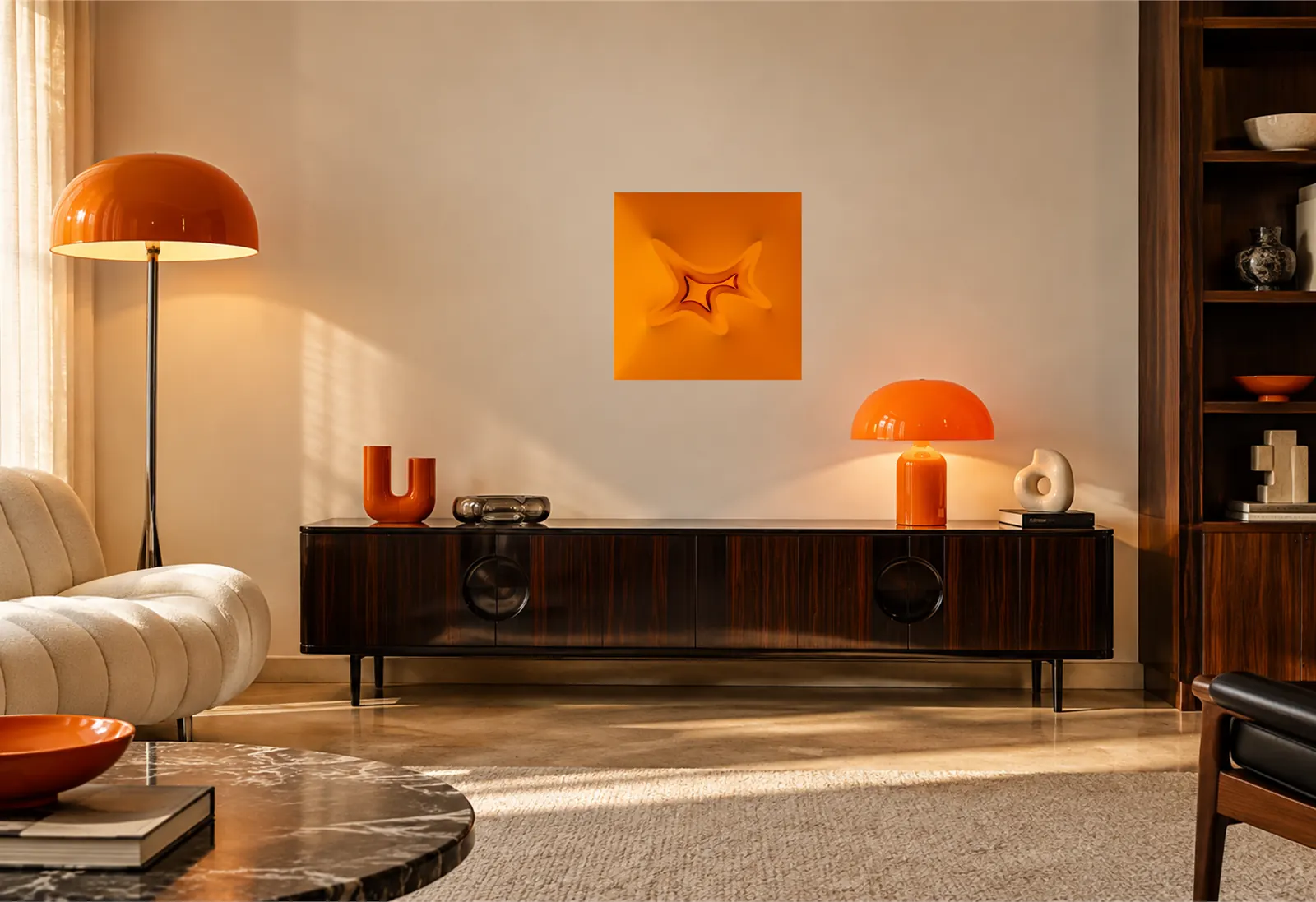
This page is a walk through that landscape, with the objects that mattered and the people behind them. It is also a conversation with Spatialism. The Triennale of 1951 that hung Lucio Fontana's neon above its staircase was the same Triennale that showed new Italian furniture. A culture of light, thin structure and clean gesture ran through both, and a contemporary relief that shares a wall with these objects is continuing a conversation older than the room it hangs in.
Every photograph on this page carries a free licence, with the author credited and a link to the source. The designs remain the work of their authors and manufacturers.
The big pieces: lamps, chairs and armchairs
A chronological walk through the large, recognisable objects of Italian design, the ones that change a room when they enter it. Each photograph carries a free licence, with the author credited and a link to the source.
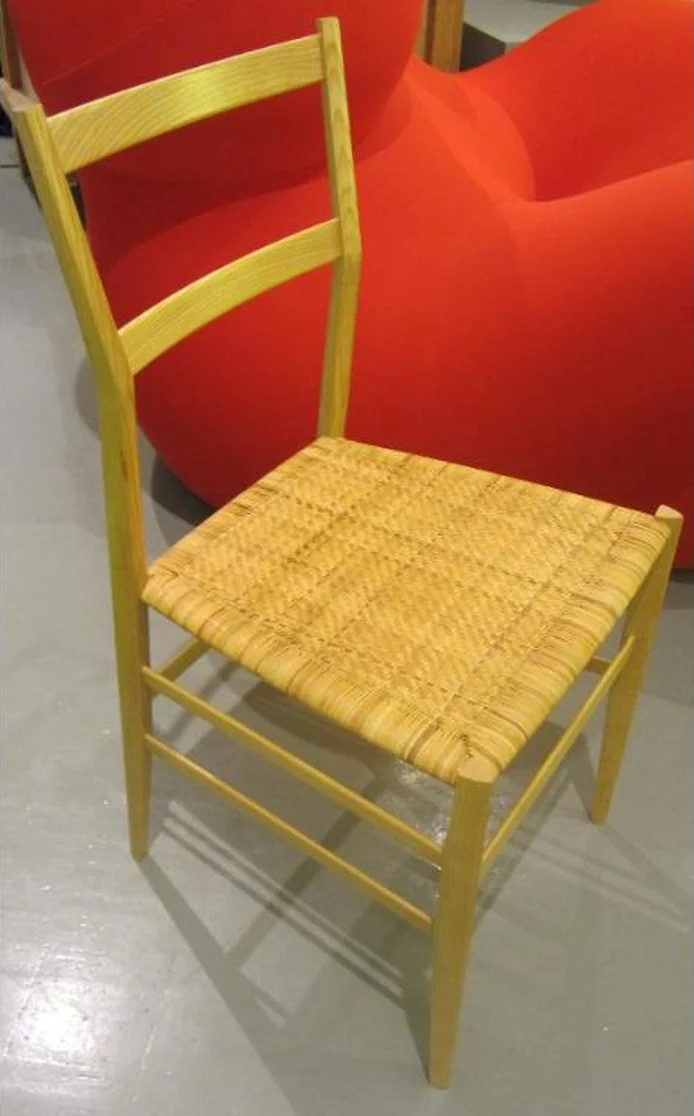
SuperleggeraThe chair that one finger can lift, drawn in 1955 and produced by Cassina from 1957. Photograph by Pava, CC BY-SA 3.0 IT, Wikimedia Commons 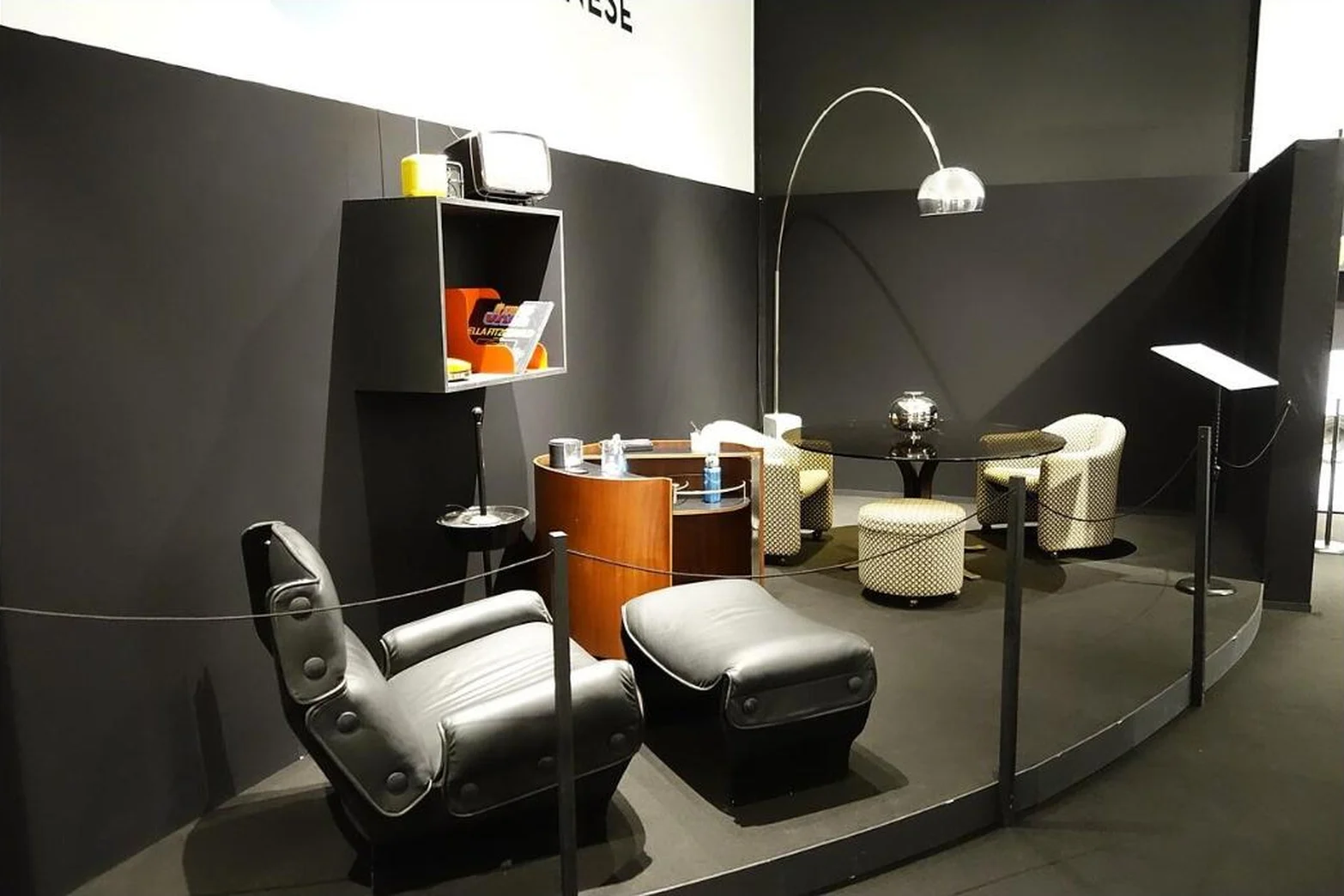
ArcoA steel arc that carries a hemispherical shade over a table, on a marble base. Flos produced it from 1962. Photograph by Guido Gerly, CC BY-SA 4.0, Wikimedia Commons 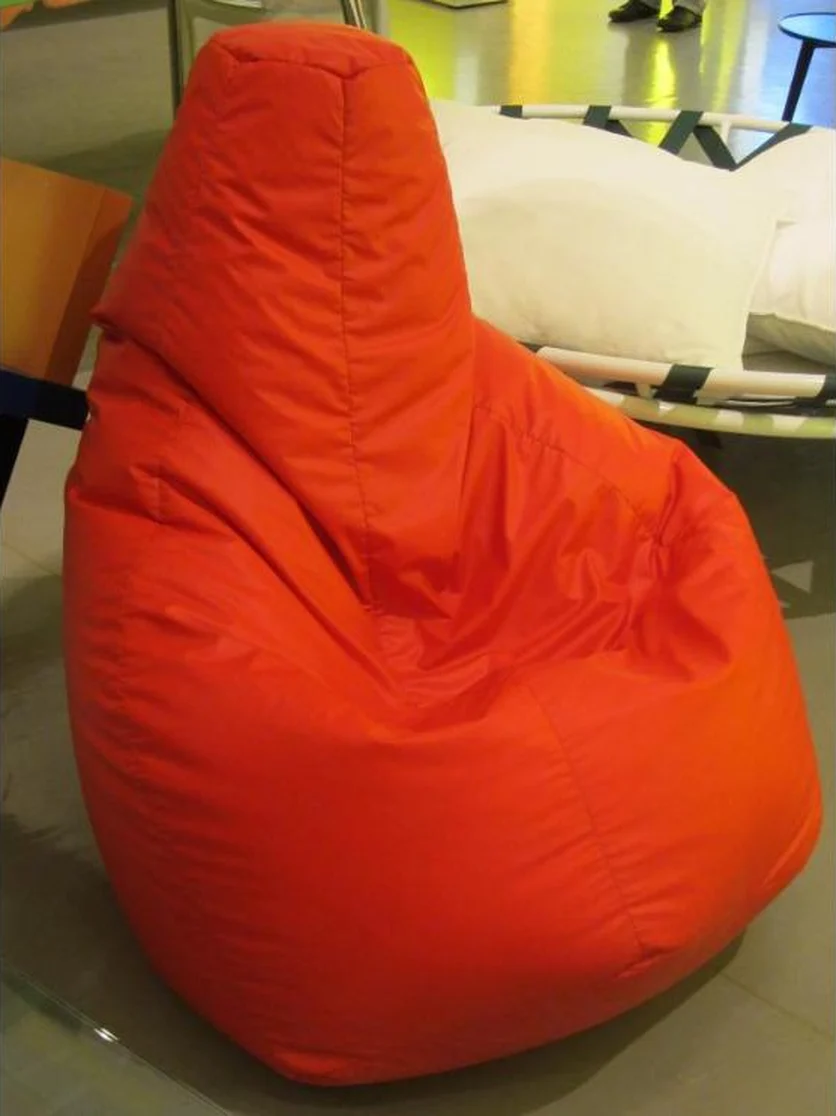
SaccoAn armchair with no structure, filled with polystyrene beads, which takes the shape of whoever sits in it. Photograph by Pava, CC BY-SA 3.0 IT, Wikimedia Commons 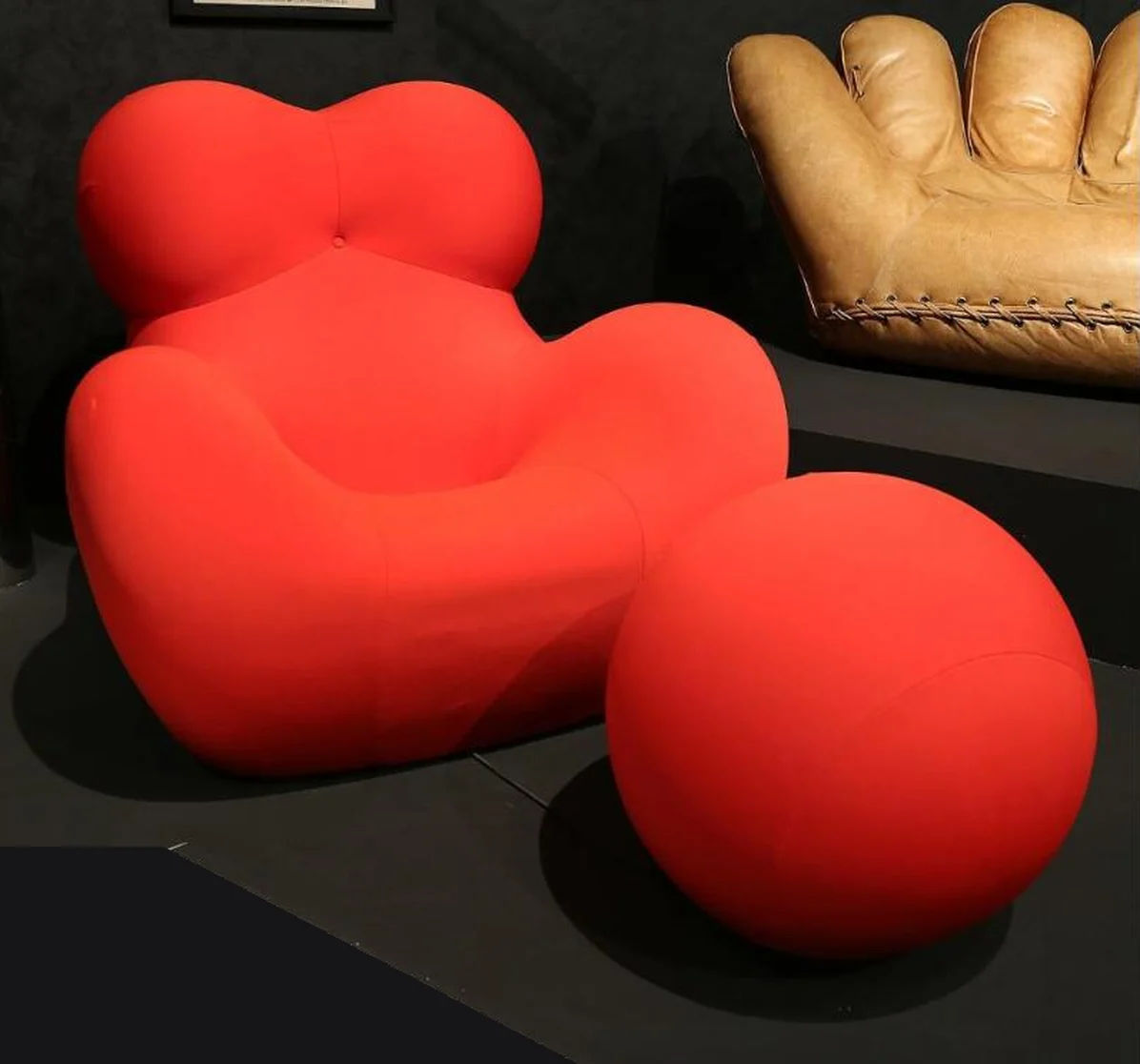
Up 5 and Up 6A body-shaped armchair in polyurethane foam, delivered flat and vacuum-packed, tied by a chain to a round pouf. Photograph by Sailko, CC BY-SA 4.0, Wikimedia Commons 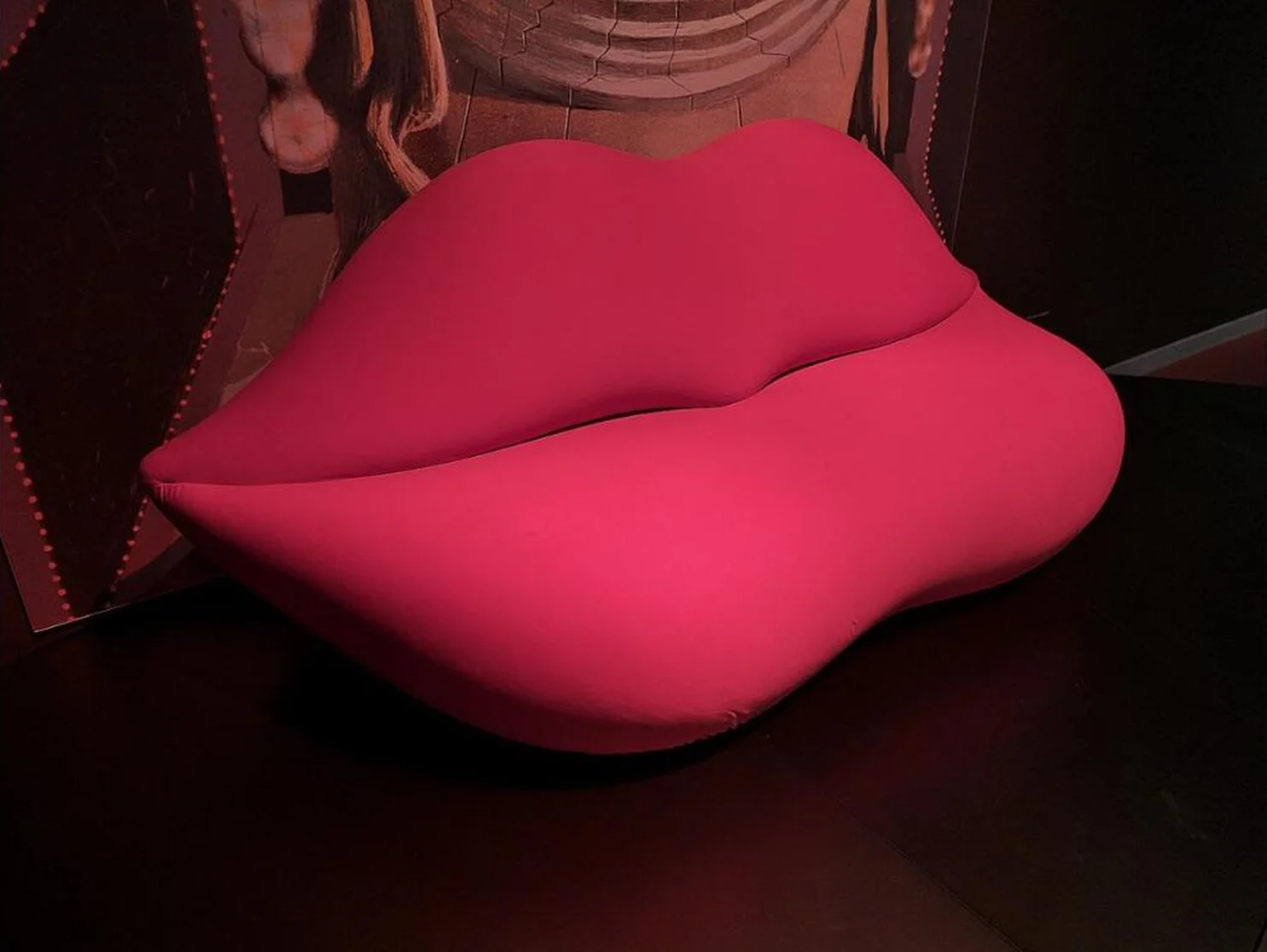
BoccaA sofa in the shape of a mouth, after Salvador Dalí's Mae West lips, made in moulded polyurethane. Photograph by Jl FilpoC, CC BY-SA 4.0, Wikimedia Commons 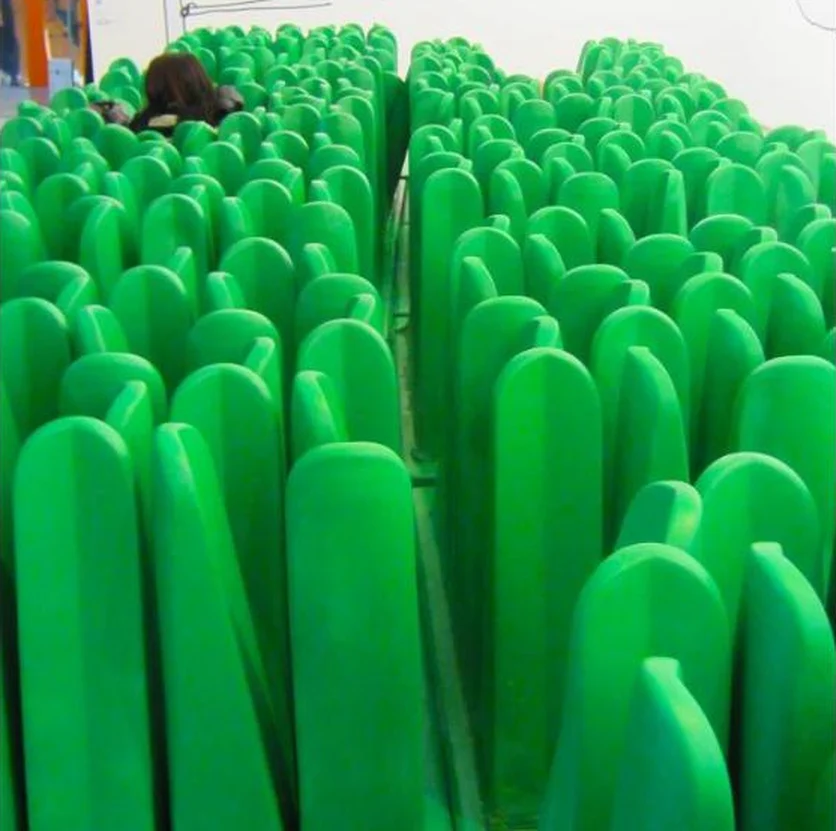
PratoneA giant meadow in polyurethane foam: a piece of furniture that is also a landscape. Photograph by Pava, CC BY-SA 3.0 IT, Wikimedia Commons 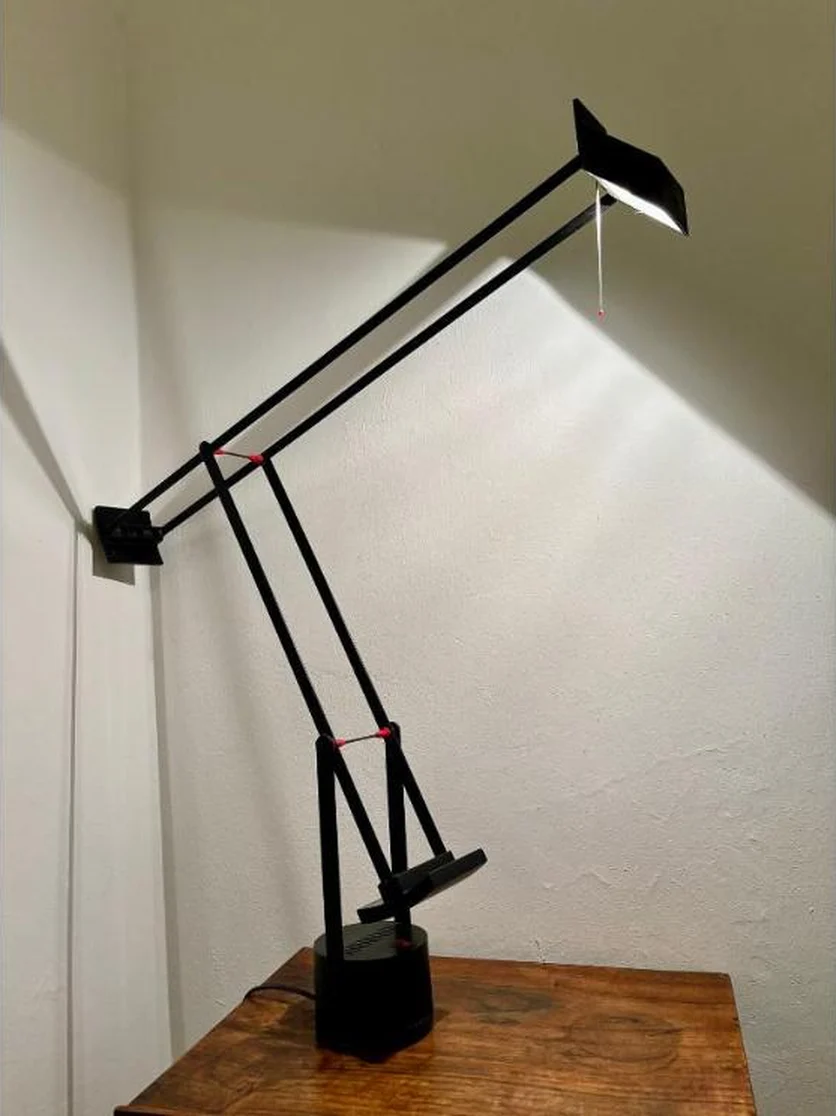
TizioA black lamp balanced by counterweights, with no cable on the arms: the current runs through the structure. Photograph by Manuelarosi, CC BY-SA 4.0, Wikimedia Commons 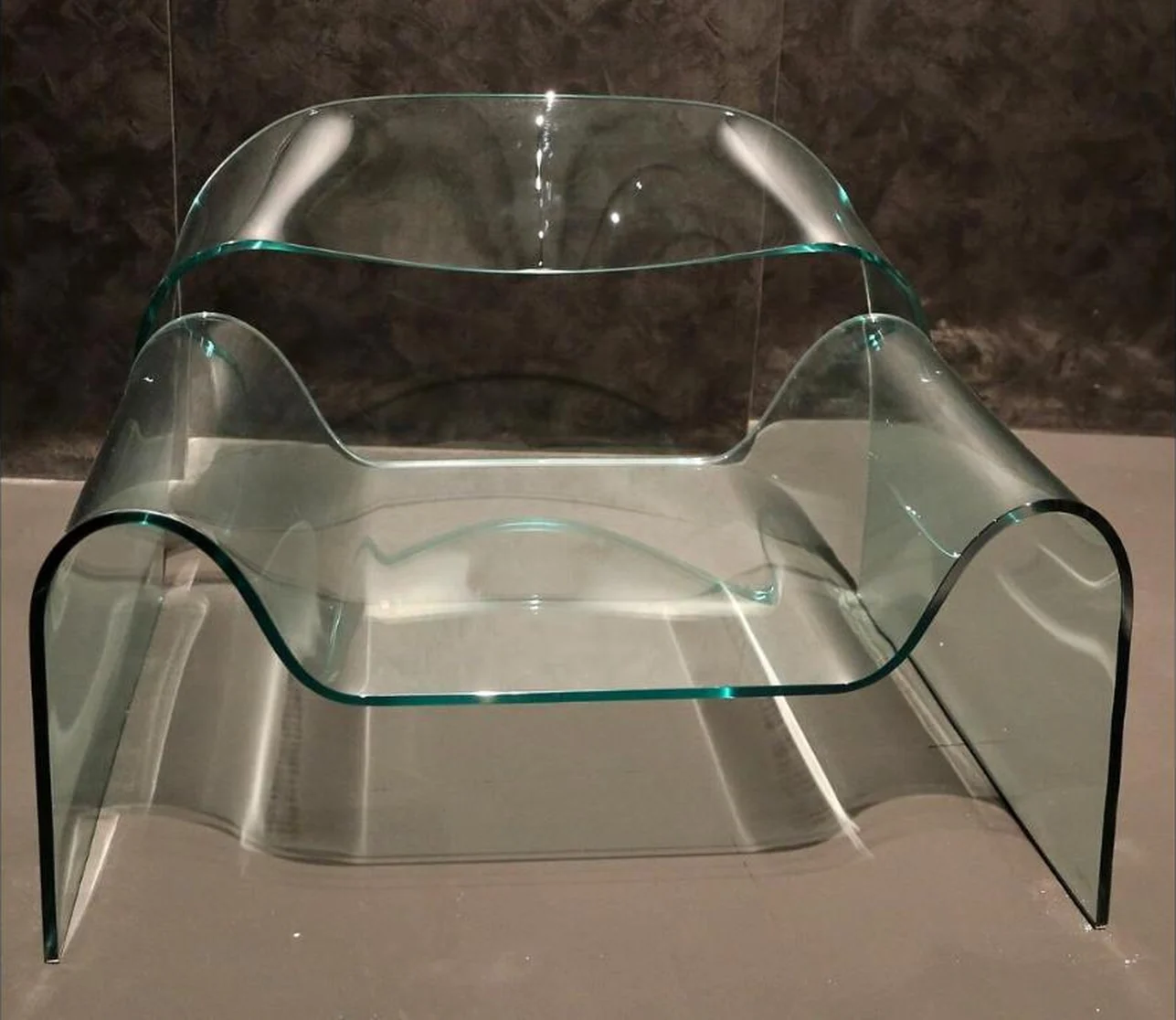
GhostAn armchair made from a single sheet of curved glass, 1987: furniture that almost disappears. Photograph by Sailko, CC BY-SA 4.0, Wikimedia Commons
Gio Ponti: the architect who drew everything
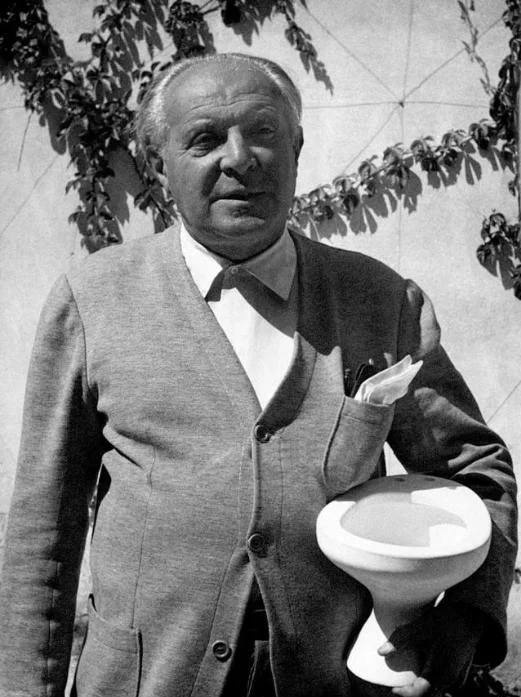
Gio Ponti, born in Milan in 1891 and died there in 1979, founded the magazine Domus in 1928 and edited it, on and off, for most of his life. He designed the Pirelli Tower in Milan, built between 1956 and 1960, and the Superleggera chair for Cassina in 1957, so light that it can be lifted with one finger. In 1933 he took the artistic direction of Fontana Arte, the house of glass and lighting founded in Milan in 1932 by Luigi Fontana.
Fontana Arte has no connection with Lucio Fontana, the founder of Spatialism: the two share a surname and work in different fields. What links the two traditions is attention to light and to the thin, precise surface. Ponti is the figure who explains why: he believed a house should be drawn as a whole, from the facade down to the cutlery, and he turned that belief into a national taste.
Franco Albini: the discipline of lightness
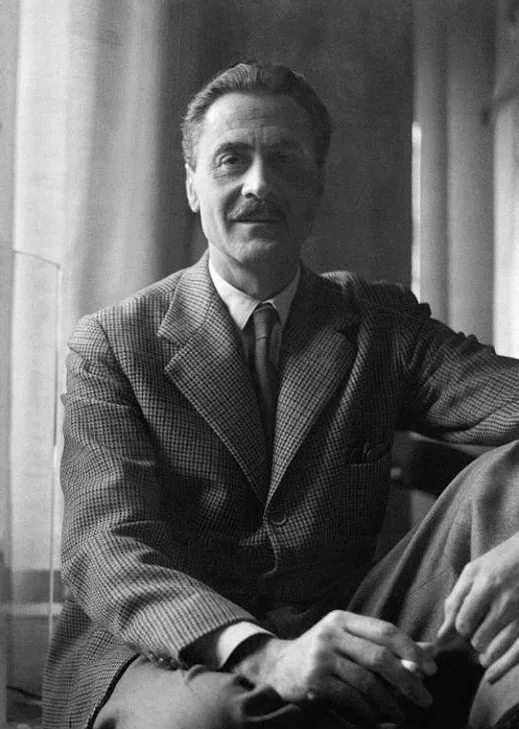
Franco Albini, born in Robbiate in 1905 and died in Milan in 1977, was a rationalist architect who designed with the lightness of a draughtsman. His Veliero bookcase dates from 1940, the Luisa chair for Poggi won the Compasso d'Oro in 1955, and with Franca Helg he built the Museo del Tesoro di San Lorenzo in Genoa between 1952 and 1956.
Albini keeps structure visible and the wall free. A shallow relief or a monochrome work hangs well beside it, because neither pushes the other off the wall. His museums remain lessons in how to hold an object in air.
Carlo Scarpa and the glass of Murano
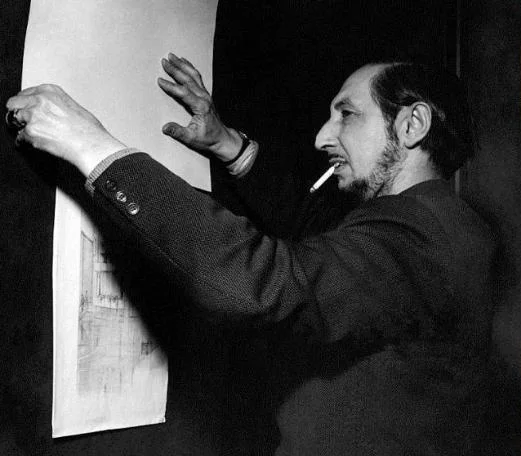
Carlo Scarpa, born in Venice in 1906 and died in Sendai in 1978, was artistic director of the Venini glassworks in Murano from 1932 to 1947. As an architect he designed the Castelvecchio museum in Verona between 1956 and 1964, the Fondazione Querini Stampalia in Venice around 1961 to 1963, and the Brion tomb at San Vito d'Altivole, begun in 1969.
Scarpa is the reference for anyone who cares about joints, thresholds and the way one material meets the next. He is also a guide to placing a sculptural wall work, where the edge and the shadow gap are part of the piece.
Carlo Mollino: the baroque of the machine
Carlo Mollino, born in Turin in 1905 and died there in 1973, was an architect, a racing driver, a pilot, a photographer and the author of furniture that looks like a muscle. His Arabesco table, drawn in 1949, has a glass top laid on a single sinuous plywood form, like a shape suspended in motion. He designed the Teatro Regio of Turin between 1965 and 1973.
Where Ponti is light and Albini is rigorous, Mollino is the dissenter: the wood is curved as if by wind, and the object seems to remember the speed of the aircraft he flew. A work with a calm surface is the right neighbour.
Gino Sarfatti and the invention of the lamp
Gino Sarfatti, born in Venice in 1912 and died in 1985, founded Arteluce in Milan in 1939 and spent his career on a single problem: how to give a light a form. He had no formal training as a designer. He designed hundreds of models, from simple wall lights to chandeliers made of constellations of bulbs, such as the 2097 of 1958, and he made them as an engineer makes a machine, with the mechanism visible and the line stripped to what it needs. Flos acquired Arteluce in 1973.
For anyone interested in light as a material, as Fontana was, Sarfatti is the essential name. He understood that a lamp is not an object with a bulb inside but an instrument that decides how a room will look at six in the evening. A relief wall lit by one of his lamps changes with the hour, which is exactly what a relief is for.

The Castiglioni brothers: Arco and Mezzadro
Achille Castiglioni (1918 to 2002) and his brother Pier Giacomo (1913 to 1968) were designers who found their ideas in the world as it was. In 1957 they conceived the Mezzadro stool, a tractor seat mounted on a steel spring and a wooden crossbar, and in 1962 they drew the Arco lamp for Flos, an arc of steel that reaches across a table from a base of Carrara marble.
Both are readymades in spirit. The tractor seat is Duchamp's idea carried into the kitchen, a found object promoted by context. Arco is a drawing in space made by a single line. In a room that holds them, a wall work with a confident, minimal gesture finds its own place.
Magistretti and Zanuso: form and machine
Vico Magistretti, born in 1920 and died in 2006, designed the Carimate chair for Cassina in 1959 and the Eclisse lamp for Artemide in 1965. Eclisse is a small bedside object with a rotating inner shell, as an eclipse is made, and it won the Compasso d'Oro in 1967. Marco Zanuso designed the Lady armchair for Arflex, presented at the Triennale in 1951, and in the early 1960s he and the German designer Richard Sapper designed televisions and radios for Brionvega, among them the folding cube radios that opened like a clamshell.
These pieces share a habit: a single strong gesture, and nothing added to it. An extroflessed work follows the same rule, with its depth as the gesture.
Olivetti: Nizzoli, Sottsass and Bellini
No company shaped the idea of Italian design more than Olivetti, the typewriter and calculator house in Ivrea led by Adriano Olivetti. Marcello Nizzoli, born in Boretto in 1887 and died in 1969, designed the Lettera 22 portable typewriter in 1950, which won the Compasso d'Oro in 1954. Ettore Sottsass, born in Innsbruck in 1917 and died in Milan in 2007, designed with Perry King the Valentine of 1969, a red plastic typewriter in its own case that was made to be carried and seen. The Programma 101 of 1965, often described as the first commercial desktop computer, was developed by the engineer Pier Giorgio Perotto, with a case drawn by Mario Bellini.
Olivetti turned an office tool into a cultural object and an industrial firm into a patron of the arts, with writers and designers on its staff. The lesson for a collector is that the best objects of the period are not those that mimic art but those that carry the same quiet ambition.

Joe Colombo and the plastic dream
Joe Colombo, born in Milan in 1930, was a painter close to the Nuclear movement before he became a designer, and he died in 1971 at the age of forty-one. His Boby trolley, designed in 1969 and produced from 1970 by Bieffeplast, is a tower of plastic drawers on casters that fits a bathroom, a studio or a living room. He drew a series of what he called total environments, units that held the functions of a house in compact modules.
Colombo belongs to the story of Spatialism for a reason that is easy to miss: he was a painter who had breathed the air of the Milan avant-garde, and his furniture asks the same question about space as the work of Fontana, only turned into use.
Gae Aulenti
Gae Aulenti, born in Palazzolo dello Stella in 1927 and died in Milan in 2012, designed the Pipistrello lamp for Martinelli Luce in 1965, and between 1980 and 1986 transformed the former railway station of Orsay in Paris into a museum. Her work moves between architecture, furniture and the staging of exhibitions. The Tour table, a glass top on wheels for FontanaArte, dates from 1993.
In a room that carries her lamps, the wall behind them is part of the composition. A relief with a calm surface gives the lamp's silhouette something to stand against.

The radical years: Sacco, Up and Pratone
At the end of the 1960s the same culture that had given the elegant chair turned on its own elegance. In 1968 Piero Gatti, Cesare Paolini and Franco Teodoro designed the Sacco for Zanotta: a leather or fabric bag filled with polystyrene beads, with no structure, which takes the shape of whoever sits in it. In 1969 Gaetano Pesce drew the Up series for C&B Italia, armchairs in polyurethane foam that were sold compressed in a vacuum pack and expanded when opened. In 1971 the Strum group, with Giorgio Ceretti, Pietro Derossi and Riccardo Rosso, produced the Pratone for Gufram, a meadow of giant green blades in which one lies down.
These objects are jokes with a serious edge. They say that comfort is a form of freedom and that the object must not impose a posture on its owner. A modest, well-made wall piece makes a fitting counterweight to their exuberance.
Mendini, Bellini, Memphis: the end of the century
Mario Bellini drew the Cab chair for Cassina in 1977: a skin of leather zipped onto a thin steel frame, a garment more than a chair. In 1978 Alessandro Mendini made the Proust chair by hand-painting a baroque armchair with a pointillist pattern, a gesture he called redesign. In December 1980 Sottsass founded the Memphis group in Milan, whose Carlton room divider of 1981 became its best-known object.
Memphis is loud in colour and pattern. Next to it, a work of the Studio should be quiet in surface and strong in form, so that colour is not asked to compete.
France: Prouvé, Perriand, Royère
Jean Prouvé, born in Paris in 1901 and died in Nancy in 1984, worked in folded and welded sheet steel. His Standard chair dates from 1934, and with Eugène Beaudouin and Marcel Lods he built the Maison du Peuple at Clichy between 1935 and 1939. Charlotte Perriand designed in 1928, with Le Corbusier and Pierre Jeanneret, the tubular steel chairs shown at the 1929 Salon d'Automne. Jean Royère, active from the 1930s, shaped rounded, sculptural furniture with a sense of colour all his own.
French pieces of this period tend to carry their structure in plain view, and they pair well with matt, monochrome surfaces.
How a contemporary relief sits beside these pieces
Choose one voice per wall. If the furniture is already sculptural, pick a work with a calm surface and let the depth do the speaking. If the furniture is plain, a stronger colour can lead.
Hang at a height that respects the piece below: the lower edge of the work usually sits 20 to 30 centimetres above a sideboard, and its width stays around two thirds of the furniture. Light the wall at a raking angle, so that the relief casts a soft shadow instead of a flat reflection. Here Sarfatti's lesson holds: the lamp is part of the work, and the shadow is half of it.
The Studio makes extroflessed works that can be proportioned to a given wall and finished in a colour chosen with the interior. For a room that already holds signed design, send the Studio a photograph of the wall and the furniture.
Where to see the originals
The ADI Design Museum in Milan presents the Compasso d'Oro collection. The Triennale Milano holds the history of Italian design exhibitions. The Museo nazionale della scienza e della tecnologia Leonardo da Vinci in Milan keeps Olivetti and Brionvega pieces, and its collections supplied several of the photographs on this page. The Vitra Design Museum, the Fondazione Querini Stampalia and Les Arts Décoratifs in Paris show furniture and interiors by the designers named here. Links are listed below.
Frequently asked questions
Does contemporary art suit a modernariato interior?
Yes, if each piece keeps its own voice. A calm, monochrome or extroflessed work gives the room a second sculptural element without competing with signed furniture.
Is Fontana Arte connected with Lucio Fontana?
No. Fontana Arte is a glass and lighting house founded in Milan in 1932 by Luigi Fontana, with Gio Ponti as artistic director from 1933. Lucio Fontana founded Spatialism.
Which Italian designers are worth knowing?
Gio Ponti, Franco Albini, Carlo Scarpa, Ettore Sottsass, Vico Magistretti, Marco Zanuso, Gae Aulenti and the Castiglioni brothers, with Jean Prouvé and Charlotte Perriand as the French counterpart.
What is modernariato?
The Italian term for collectible objects of the twentieth century, mainly furniture, lamps and everyday objects designed from the 1930s to the 1980s, when they carry a known designer or manufacturer.
Who was Gino Sarfatti?
A Venetian-born designer who founded the lighting house Arteluce in Milan in 1939 and designed hundreds of lamps. Flos acquired Arteluce in 1973.
Can the Studio make a work for a vintage interior?
Yes. Send a photograph of the wall and the furniture, and the Studio proposes scale, colour and depth for that room.
Related reading: Spatialism, History of contemporary art. Works by the Studio: Works, Extroflessed art.
Discuss a commission