The manifesto and the painters
Futurism was launched in 1909 when Filippo Tommaso Marinetti published the Futurist manifesto on the front page of Le Figaro. In 1910 the Futurist painters, Umberto Boccioni, Carlo Carrà, Luigi Russolo, Gino Severini and Giacomo Balla, signed their own manifesto. They wanted an art that expressed speed, movement and modern life.
This is episode 1 of the series From canvas to space: how the work leaves the canvas and enters space.
A manifesto for sculpture
On 11 April 1912 Boccioni published the Technical Manifesto of Futurist Sculpture. It develops the idea of sculpting the environment around a figure, and shows the influence of the sculptor Medardo Rosso. For Boccioni a work does not end at its outline: it continues into the space that surrounds it.
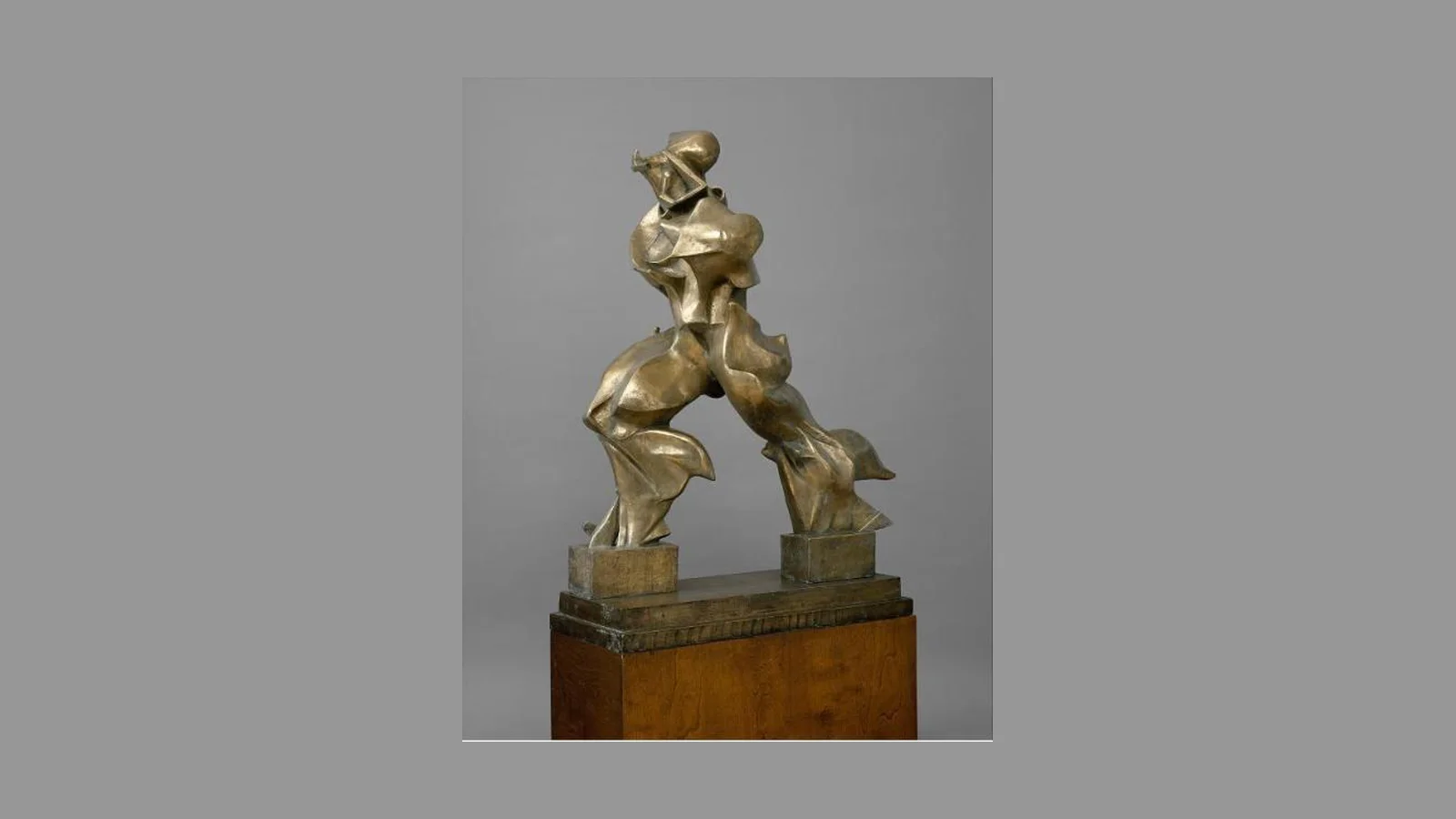
Unique Forms of Continuity in Space
In 1913 Boccioni made Forme uniche della continuità nello spazio, one of a series of striding figures. Where Balla repeated forms to show movement, Boccioni synthesised different positions into a single dynamic figure. The original was made of plaster. The bronzes in museums, such as those at MoMA, the Metropolitan Museum and Tate, were cast after his death in 1916. A version of the sculpture appears on the Italian 20-cent euro coin.
Why it matters for what follows
Boccioni treats space as a continuation of the object, not as a container. This is the first step of the path that leads, through the readymade, abstraction, the gesture and the combine, to the Spatialism of Fontana and to extroflexion. According to the Kunsthalle Messmer, the Manifiesto Blanco of 1946 took up the ideas of Futurism.
Boccioni died in 1916, so his works are in the public domain and can be reproduced with a credit to the source.
Frequently asked questions
Who was Umberto Boccioni?
An Italian painter, sculptor and theorist, one of the leading figures of Futurism. He died in 1916.
Why are Boccioni's bronzes dated after his death?
The original of Unique Forms of Continuity in Space was in plaster. The bronzes were cast later from it.
What did Futurism want?
An art that expressed speed, movement and modern life, breaking with academic tradition.
Join the conversation.
Share a comment below for public discussion after review. For a private question or an idea for a future article, write directly to the Studio.
Ask the Studio privatelyExplore the history of contemporary art, Spatialism, Collections.
Discuss a commission