What a readymade is
A readymade is an everyday manufactured object presented as art. The Metropolitan Museum explains that the object becomes a work of art because the artist decides it will be designated as such. Duchamp chose mundane, mass-produced objects precisely because they had nothing to do with artistic skill.
This is episode 2 of the series From canvas to space.
Bicycle Wheel, 1913
Tate dates Duchamp's earliest readymades to 1913, with Bicycle Wheel, a wheel mounted on a wooden stool. The original is lost. The Centre Pompidou notes that the wheel was fixed to the stool, so it is strictly an assisted readymade, and that its version was produced in 1964 by the Galleria Schwarz in Milan under Duchamp's supervision.
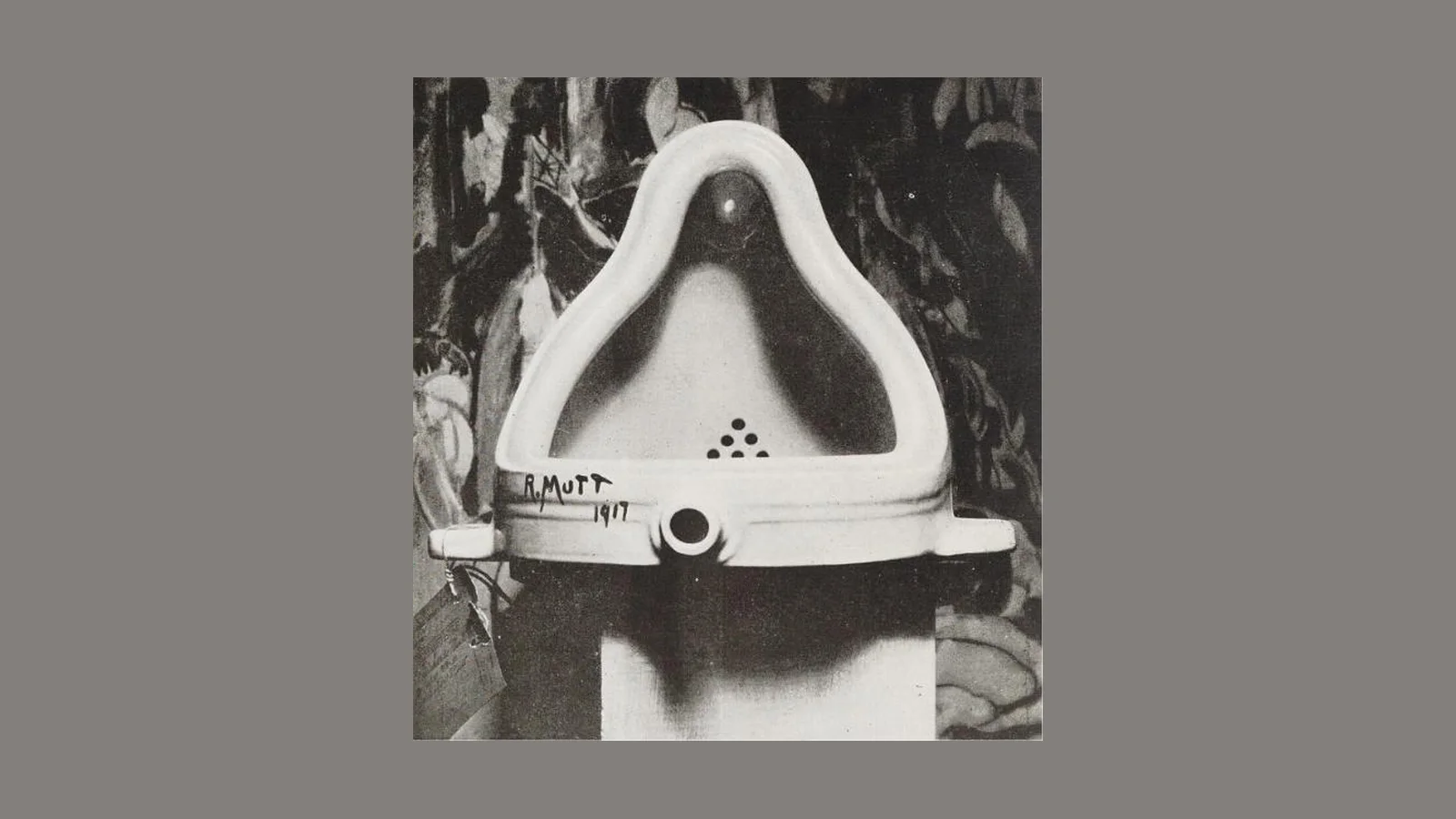
Fountain, 1917
In 1917 Duchamp submitted a porcelain urinal signed R. Mutt to the exhibition of the Society of Independent Artists in New York. It was hidden from view during the show. The original is lost: what remains is a photograph by Alfred Stieglitz published in the journal The Blind Man, and later replicas.
Between 1915 and 1923 he also built The Large Glass, now at the Philadelphia Museum of Art.
What it changes
After Duchamp the value of a work can lie in the idea and in the decision, not only in the hand. For what comes next, the object is no longer a representation of something: it is itself the work. Duchamp died in 1968, so his works are still protected by copyright: here they are linked to the museums.
Frequently asked questions
What is a readymade?
An everyday manufactured object chosen by the artist and presented as a work of art.
Is Bicycle Wheel a pure readymade?
Not strictly: the wheel was mounted on a stool, so it is usually called an assisted readymade.
Where can Duchamp's works be seen?
The Philadelphia Museum of Art holds an extensive Duchamp collection. Tate, the Centre Pompidou and MoMA also hold works.
Join the conversation.
Share a comment below for public discussion after review. For a private question or an idea for a future article, write directly to the Studio.
Ask the Studio privatelyExplore the history of contemporary art, Spatialism, Collections.
Discuss a commission