Who painted the first abstract work
There is no single answer. Smarthistory notes that Kandinsky, Mondrian and Malevich each reached abstraction gradually, and that dating the first fully abstract work is difficult. Hilma af Klint has recently been put forward as another candidate.
This is episode 3 of the series From canvas to space.
Kandinsky: abstraction as spiritual
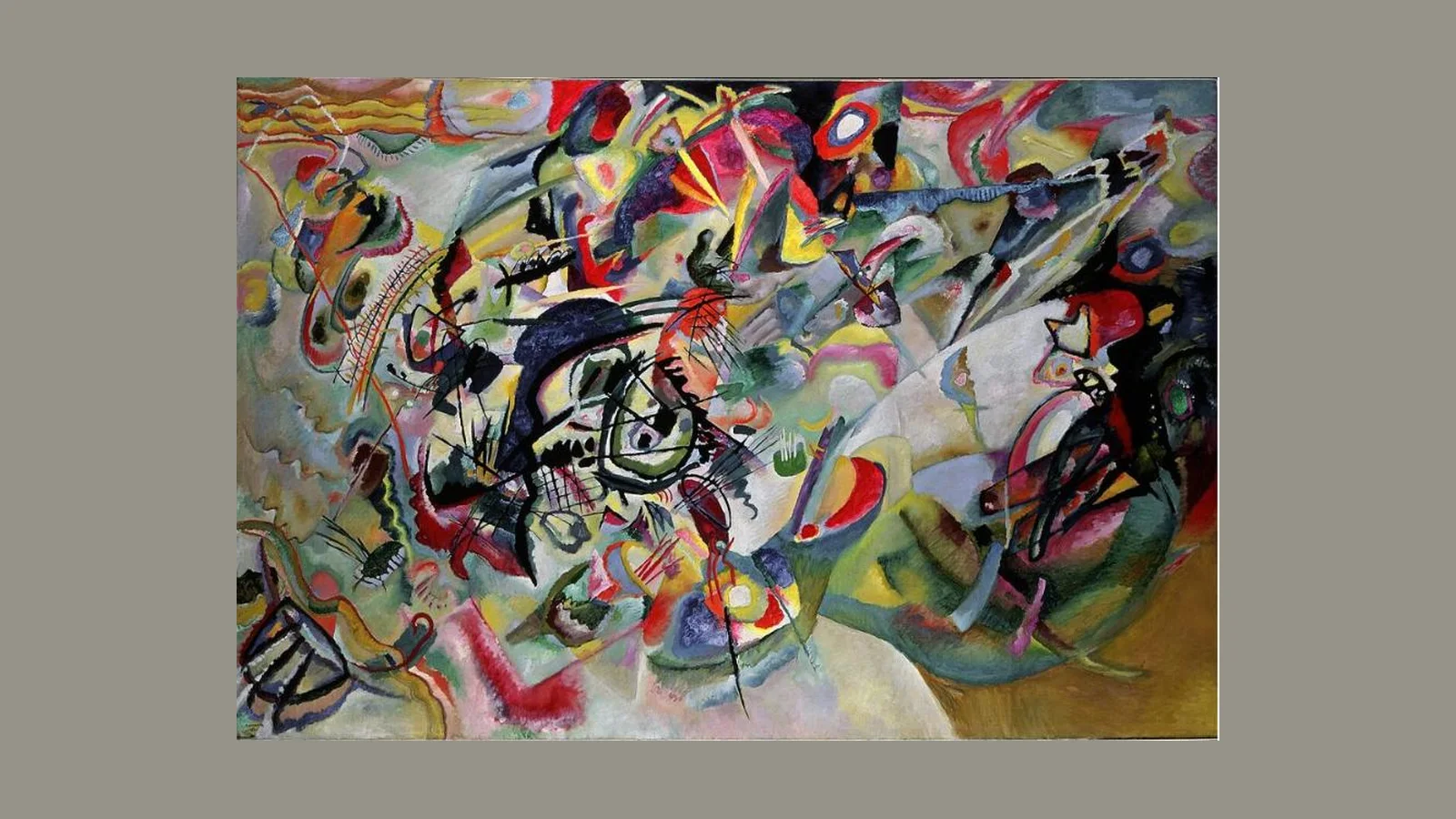
Wassily Kandinsky is often regarded as a pioneer of European abstraction. His watercolour known as the first abstraction, a study for Composition VII, is signed 1910 but most historians date it to 1913. His text on the spiritual in art justified abstraction as more spiritual than representation.
Malevich: Black Square
In 1915 Kazimir Malevich showed Black Square at the Last Futurist Exhibition 0,10 in Petrograd. He called his abstract compositions Suprematism. Tate describes it as one of the most iconic abstract artworks. Later came Suprematist Composition: White on White (1918).
Mondrian: neoplasticism
Piet Mondrian moved gradually from the natural subject to the grid. He called his approach neoplasticism and aimed at the destruction of natural appearance, in favour of the plastic expression of true reality. His Composition with horizontal and vertical lines, colour and white remains the reference for geometric abstraction.
What changes for space
With abstraction the picture surface stops being a window and becomes the subject itself. The next step is to treat that surface as a physical thing: to cut it, pour on it, push it forward. Kandinsky, Malevich and Mondrian died in 1935 and 1944, so their works are in the public domain.
Frequently asked questions
Who painted the first abstract painting?
It cannot be said with certainty. Kandinsky, Malevich and Mondrian arrived at abstraction by different and gradual paths.
What is Suprematism?
The term Malevich used for his abstract art, based on pure geometric forms and colour.
What is geometric abstraction?
Abstract art built from lines, shapes and colour, without reference to natural appearance.
Join the conversation.
Share a comment below for public discussion after review. For a private question or an idea for a future article, write directly to the Studio.
Ask the Studio privatelyExplore the history of contemporary art, Spatialism, Collections.
Discuss a commission