The canvas on the floor
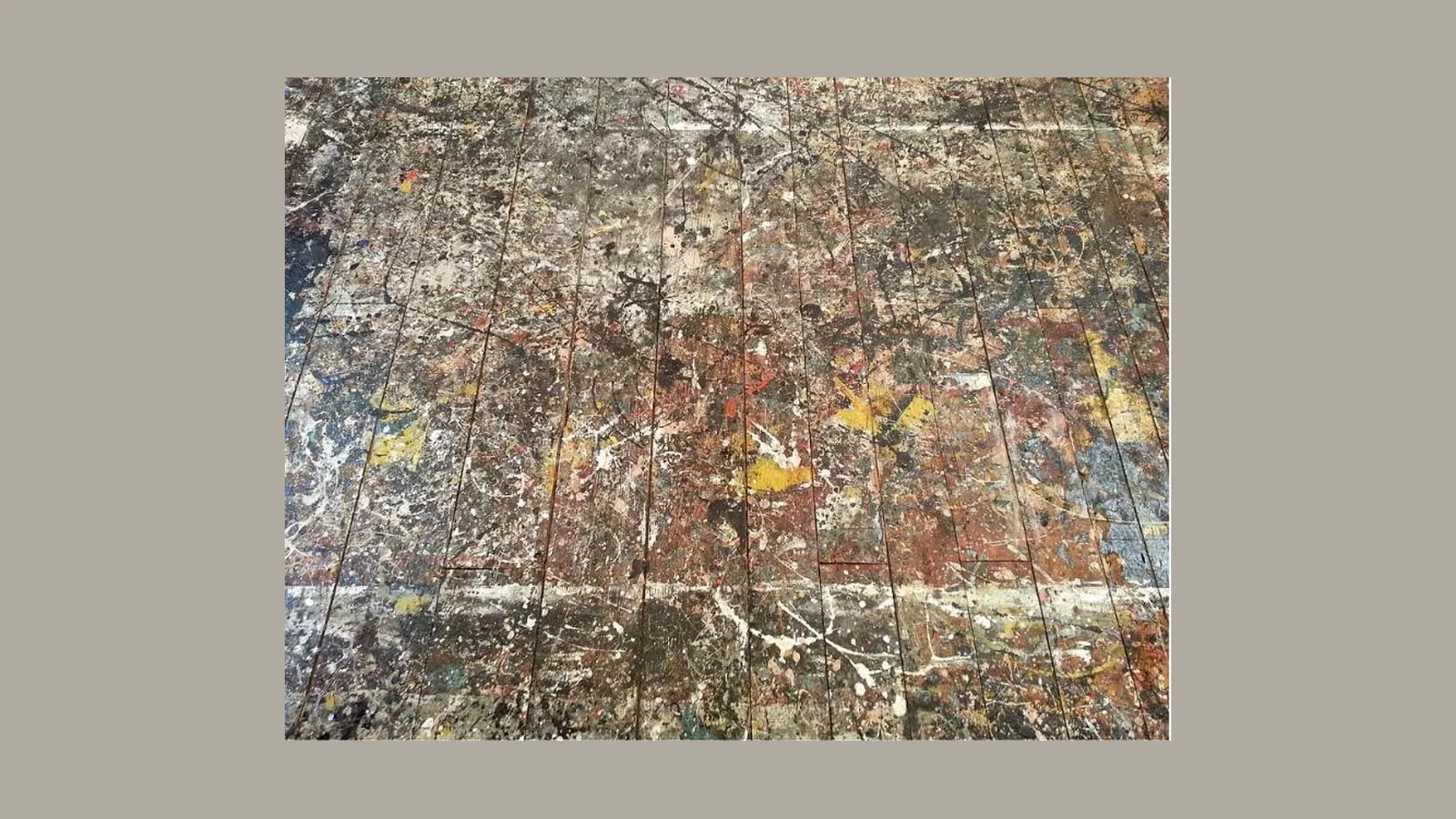
In November 1945 Jackson Pollock and Lee Krasner moved to Springs, on Long Island. After the move he began painting with his canvases laid out on the studio floor, in what has been called the drip technique, although pouring is a more accurate description. His most famous paintings date from the drip period, between 1947 and 1950.
This is episode 4 of the series From canvas to space.
Number 1A, 1948
Number 1A, 1948, in oil and enamel on canvas, was acquired by the Museum of Modern Art in January 1950. Seen from above, the painting is a record of the movements that made it. In 1949 Life magazine gave Pollock a four-page spread, and in 1950 the photographer Hans Namuth filmed him at work.
Action painting
The term action painting was coined by the critic Harold Rosenberg in the article The American Action Painters, published in ARTnews in December 1952. Tate applies it to artists, Pollock among them, whose approach emphasised the physical act of painting as an essential part of the finished work.
What it changes
The painting is no longer a view but the trace of an event, made on the horizontal plane and around the whole body of the artist. It is the step that prepares the gesture of the cut and the extroflession. Pollock died in 1956: his works are linked here to the museums.
Frequently asked questions
What is action painting?
Painting in which the physical act of painting is an essential part of the work. The term was coined by Harold Rosenberg in 1952.
Did Pollock really drip the paint?
He poured and dripped it onto canvases laid on the floor. Pouring is considered the more accurate word.
Where can Number 1A, 1948 be seen?
At the Museum of Modern Art in New York, which acquired it in 1950.
Join the conversation.
Share a comment below for public discussion after review. For a private question or an idea for a future article, write directly to the Studio.
Ask the Studio privatelyExplore the history of contemporary art, Spatialism, Collections.
Discuss a commission