The short answer
Extroflexion is the technique of pushing a monochrome canvas outward from behind, with nails, frames or structures, until it forms a relief. It began in Milan in the late 1950s with Enrico Castellani and Agostino Bonalumi, in the climate opened by Lucio Fontana. Fontana opens the canvas with holes and cuts; they bring it toward the viewer.
This is episode 7 of the series From canvas to space.
Milan, 1958 to 1960
In 1957 Castellani, born in Castelmassa in 1930 and trained in Belgium as a painter and architect, returned to Italy and met Piero Manzoni, Lucio Fontana and Agostino Bonalumi in Milan. In 1958 Bonalumi, Castellani and Manzoni exhibited together at Galleria Pater. In December 1959 Castellani and Manzoni opened Galleria Azimut and launched the journal Azimuth, which ran to two issues. Their shared idea was an art that does not imitate but is real in itself.
Castellani: light as subject
In 1959 Castellani showed his first Superfici, including the Superficie nera in rilievo. He then developed a rigorous order of nails that lifts the canvas in regular sequences. Colour stays monochrome, almost always white. What changes is light: depressions and raised areas cast shadows that shift with the hour and with the viewer's position. He represented Italy at the Venice Biennale in 1964 and 1966, took part in Documenta 4 in 1968 and received the Praemium Imperiale for painting in 2010.
Bonalumi: the painting-object
Agostino Bonalumi, born in Vimercate in 1935, works on monochrome canvases modelled from behind with internal structures, so that the surface swells, folds and forms ridges. His first trials date from 1959. Gillo Dorfles called these works pittura-oggetto, painting-object: the canvas stops representing space and presents it in its extension. According to critics, Castellani works mainly on light and shadow, Bonalumi on the sculptural dimension of the canvas.
Simeti: the oval
Turi Simeti was born in Alcamo, Sicily, in 1929, studied law in Palermo, moved to Rome in 1958, where he frequented Alberto Burri's workshop, then to Milan. In 1965 he took part in the ZERO Avantgarde exhibition in Fontana's studio, and in 1966 Galleria Millennium presented Bonalumi, Castellani, Simeti. His signature is the raised oval, repeated on monochrome surfaces.
What sets them apart from Fontana
Fontana cuts and pierces: space enters from behind through the cut. The artists of extroflexion do not cut: they push the surface toward the viewer. The result is an object that occupies the room and lives on the light that crosses it. Several sources report that Donald Judd regarded Castellani as a forerunner of Minimalism, which is where episode 8 begins.
In the Studio's research
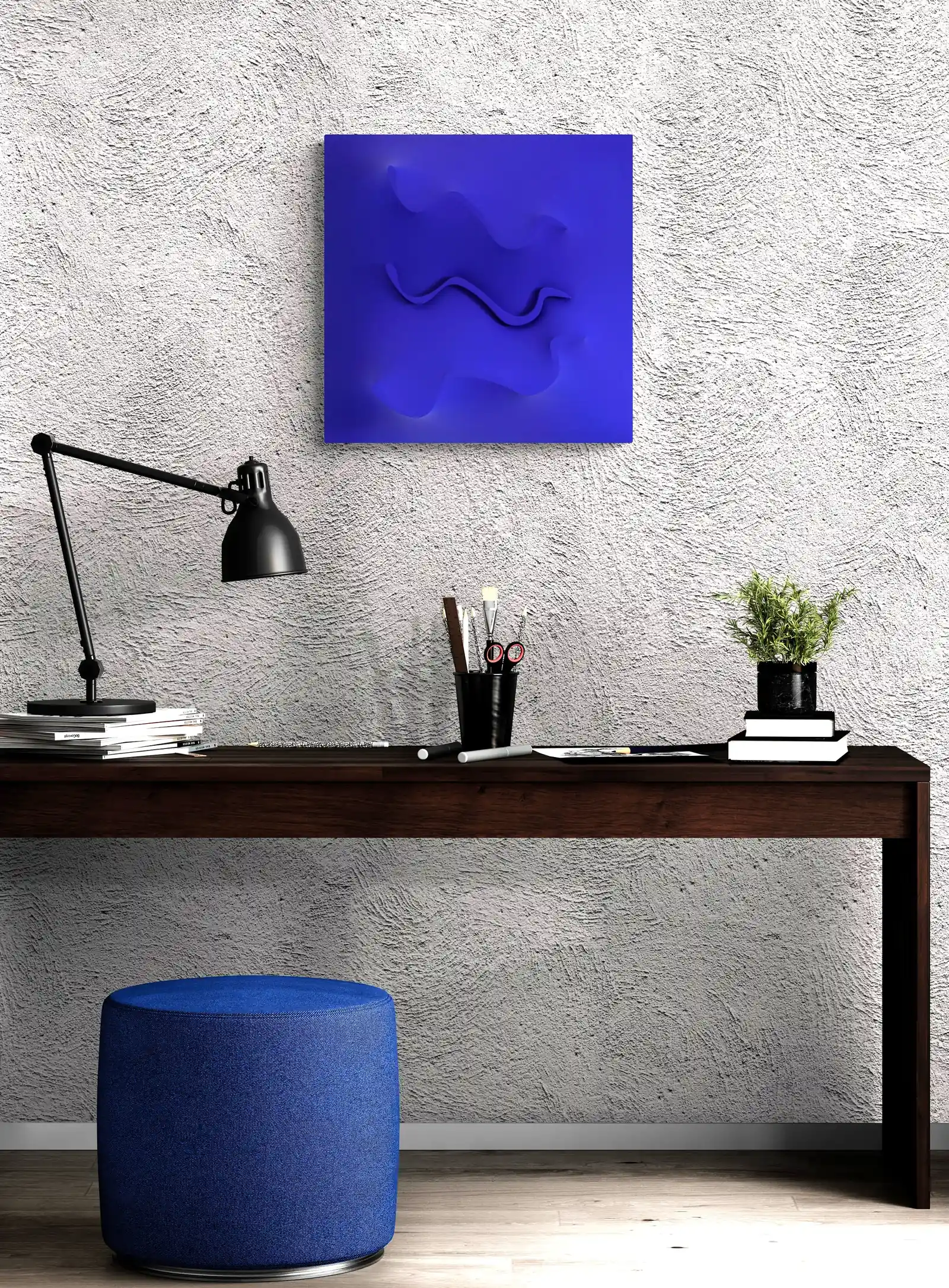
The Studio's work comes from this line. The pieces are extroflessed and modular: each module can be moved to obtain different light effects and can be made in other colours. Light defines the relief, as in Castellani's Superfici, but the composition stays adjustable by the architect or the collector.
Frequently asked questions
What is extroflexion in art?
The canvas pushed outward from behind with nails, frames or structures, creating relief.
Who invented extroflexion?
There is no single inventor. Castellani and Bonalumi developed it in Milan between 1958 and 1959, in the climate opened by Fontana.
What is the difference between Fontana's cuts and extroflexion?
Fontana opens the canvas with a cut. Extroflexion pushes it toward the viewer without opening it.
Join the conversation.
Share a comment below for public discussion after review. For a private question or an idea for a future article, write directly to the Studio.
Ask the Studio privatelyExplore the history of contemporary art, Spatialism, Collections.
Discuss a commission